
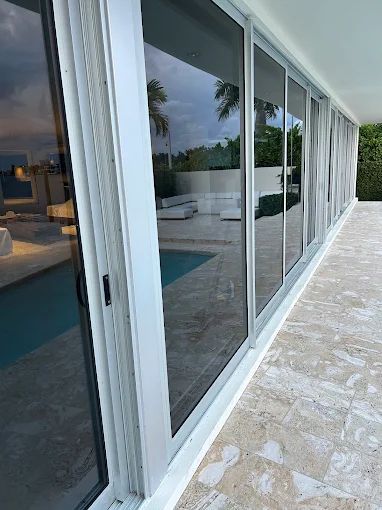
Florida's salt air, blowing sand, and humidity wear out sliding door rollers, tracks, and hardware faster than in most climates, so coastal homes need more frequent cleaning and service. For storm protection, impact-rated glass or approved shutters are required for new construction and qualifying replacements in Florida's wind-borne debris regions — which include Duval County's coastal communities. Always confirm current requirements with your local building department.
How Florida's climate attacks sliding doors
- Salt air corrodes rollers, tracks, screws, and lock mechanisms
- Blowing sand grinds down wheels and packs into tracks like sandpaper
- Humidity accelerates rust and can warp or swell components
- Heavy rain finds its way in through worn seals and clogged weep holes
- Intense sun degrades weatherstripping and seals over time
This is why coastal doors in Jacksonville Beach, Ponte Vedra, St. Augustine, and Fernandina Beach tend to need roller and track service sooner than inland homes.
Coastal maintenance checklist
- Clean the track monthly near the coast (every 2–3 months inland)
- Rinse salt residue off exterior hardware periodically
- Keep weep holes clear so rain drains instead of pooling
- Use a dry PTFE or silicone lubricant — never oil or grease
- Have the door professionally serviced at the first sign of dragging or a failing lock
Our full maintenance guide covers the how-to in detail.
Impact glass and Florida's wind-borne debris rules
Florida's Building Code requires impact-rated glazing (or approved shutters) for exterior openings in designated wind-borne debris regions (WBDR). In general terms, a site is in the WBDR when it's within one mile of the coastal mean high-water line where the design wind speed is 130 mph or greater, or anywhere the design wind speed is 140 mph or greater.
For Northeast Florida, that means Duval County's coastal communities — Atlantic Beach, Neptune Beach, Jacksonville Beach, and Mayport — are generally in the WBDR and require impact-rated glazing or approved protection for new construction and qualifying replacements. Much of inland Jacksonville has lower design wind speeds and often falls outside the WBDR.
You can check your site's design wind speed and WBDR status with the ASCE 7 Hazard Tool, and confirm local rules with your building department. ASCE 7 Hazard Tool
The Florida '25% rule' for replacements
Under the Florida Building Code, if a home in the wind-borne debris region (built before the statewide code took effect on March 1, 2002) has more than 25% of its total glazed opening area replaced within a rolling 12-month period, the replacements generally must meet current impact standards. It's measured by glass area, not by the number of openings — and a single large sliding glass door can be a big share of that area. Confirm how this applies to your project with your building department.
Preparing sliding doors for hurricane season
- If your glass isn't impact-rated, plan approved shutters or protection for openings
- Make sure the door locks and latches securely — a poorly latched door is a weak point in high wind
- Clear tracks and weep holes so wind-driven rain can drain
- Replace worn weatherstripping to reduce water intrusion
- Address a dragging or misaligned door before storm season, not during it
Impact glass can also qualify you for wind-mitigation insurance credits in Florida — ask your insurer about a wind-mitigation inspection. Coverage and credits vary by policy.